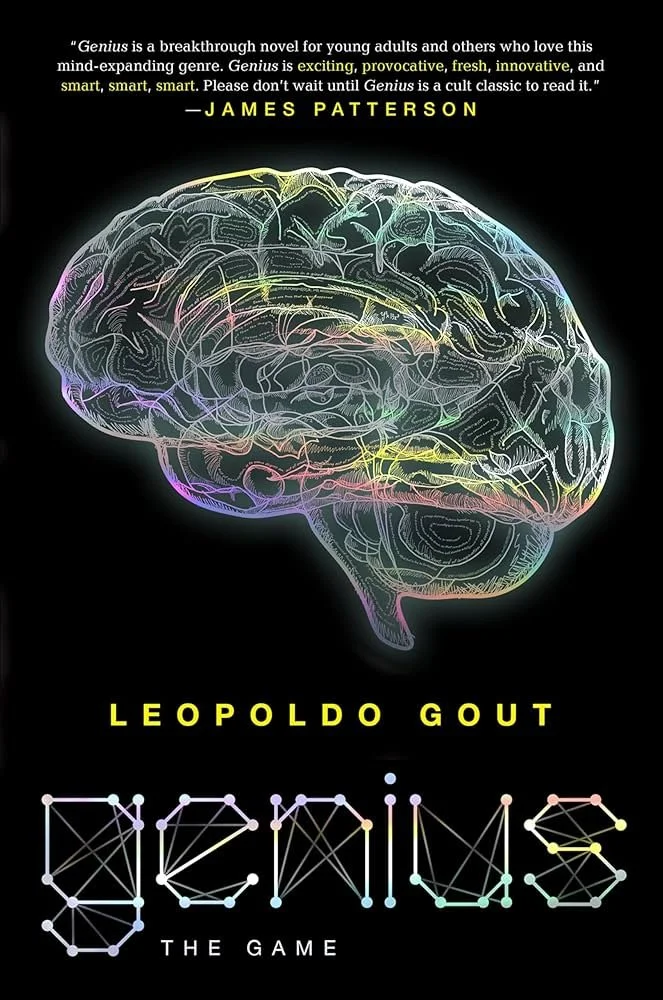
Genius: The Game
Leopoldo Gout

Reviewed 4-13-2026
As a book written for teens and illustrated with a couple diagrams, it does a great job at showcasing various points of view and cultures in interesting ways. Through the idea of a group of prodigies, brought together by a prodigy with some renown, these teenagers from all over the world compete to win “The Game.” What’s the prize? No one knows, but it’s said to change the world, so they all try their best to win. Our main 3 characters are hackers known all over the world as “The Lodge.” Rex is a poor Hispanic kid coder who lives in California; Tunde is a scrapyard engineer from Nigeria and Painted Wolf (Cai) is Chinese and essentially a spy who exposes corporate corruption online. Each has their own reasons for wanting to go to the competition and as they all meet for the first time in person, I felt their connection almost immediately. One of the main driving factors is that Tunde is under pressure from a local warlord to build a GPS jammer or his village will be harmed. I felt immediate compassion for this kid as it’s an impossible situation and the willingness of his friends to help was heartwarming. Rex’s motivations are centered around finding his brother who walked out on the family, but he needs a quantum computer to run the program he developed. Luckily the site of The Game has one, so he gets to help a friend and find a long lost family member. Painted Wolf mostly goes for Tunde, as the entire competition risks people finding out her real name, which would put her family at risk. They worked their way up in Chinese society and their daughter being a vigilante would most likely get them killed. It’s an interesting balance of characters and I felt like they were all given enough depth that I could understand their motivations.
With all the storylines, I was wondering how the story was going to wrap it up given the length of the novel. Come to find out, it’s a series, which makes the cliffhanger ending a bit more forgivable though I was initially unhappy with it because of its abruptness. There is a lot of coding jargon and though there are quite a few pictures, much of it is just nonsense. The Game isn’t really the focus of the story, more a vessel for the characters to interact with. In addition to the main 3, there are a couple other characters that are mentioned. Only a couple get any development, so I found it odd to name every single one. Off the top of my head, and having just read it, I can only recall Halil and Anj. We do, however, get a peak behind the curtain at what The Game’s organizer, Kiran Biswas’, plan is. His motivations are left ambiguous for now, but there’s something off about everything that he’s set up so far. It does make me want to continue, but I’m definitely not the target audience.
The characterization in this story is top notch. I feel like I understand the main 3 and really care about their success. Despite some of the scenarios lacking depth, they were enough of a vessel for the characters to shine. If you don’t think about the coding jargon too much, it’s a pretty solid story. The companionship of the main cast gives the story a found family vibe that I couldn’t help but become immediately invested. I would recommend this to the proper audience, teenagers, as a novel that explores diversity, exemplifies empathy and inspires change. However, if you want a digestible story with great characterization, this story is a solid pick.